Customers rarely become customers after a single interaction.
They might first hear about your business through an AI search result, return later after seeing a Google ad, compare your services through organic search, follow you on social media, and finally respond to an email or remarketing campaign.
None of those interactions happen in isolation.
Each one helps build confidence and moves a potential customer closer to making a decision.
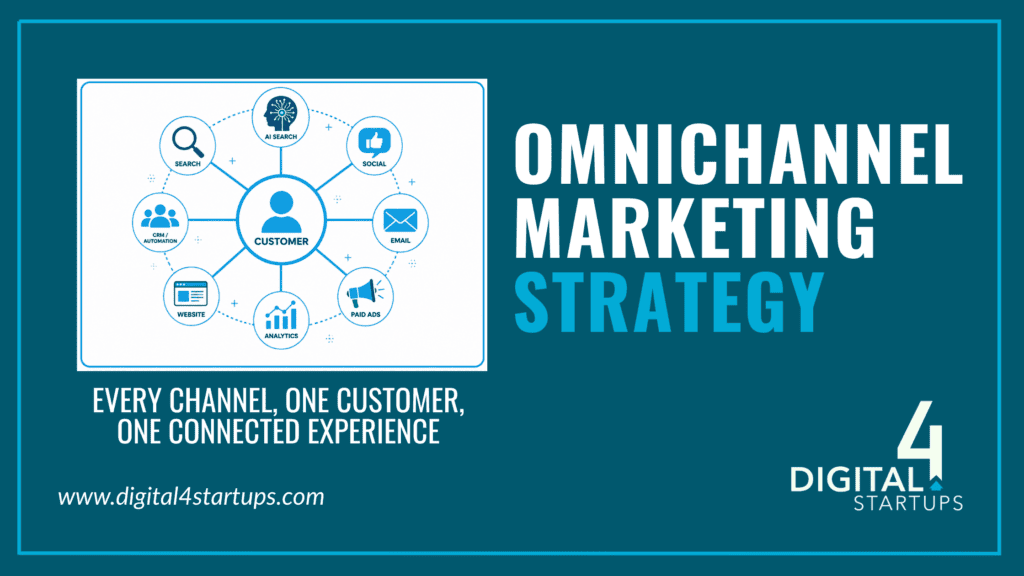
That’s the purpose of an omnichannel marketing strategy. Instead of treating every marketing channel as a separate initiative, you create one connected experience that supports customers wherever they choose to engage with your business.
Done well, an omnichannel strategy creates a better customer experience while improving the performance of every marketing dollar you invest.
What Is Omnichannel Marketing?
An omnichannel marketing strategy coordinates every customer touchpoint around a single business objective.
Your website, search campaigns, SEO, AI search visibility, email marketing, social media, and analytics all work together instead of operating independently.
Customers experience one brand.
One message.
One consistent journey.
The goal isn’t to appear on every platform.
The goal is to show up where your customers are most likely to make decisions and provide the information they need at each stage of that journey.
Multichannel vs. Omnichannel
Many businesses already market across several platforms.
That doesn’t automatically make them omnichannel.
Multichannel marketing often looks like this:
- SEO team publishes content.
- PPC team manages paid campaigns.
- Social media posts on its own schedule.
- Email marketing runs independently.
Each channel performs its own job.
Omnichannel marketing connects everything together.
For example:
- A prospect finds your business through Google Search.
- They visit your website and download a guide.
- Email provides additional education.
- Remarketing reinforces your message.
- AI search surfaces your expertise during future research.
- The customer returns ready to contact your team.
Every interaction supports the next one.
Why Omnichannel Matters More Than Ever
Today’s customers move between devices, platforms, and search experiences without thinking about it.
They might:
- Search Google.
- Ask ChatGPT or Gemini for recommendations.
- Read online reviews.
- Visit your website.
- Compare competitors.
- Return days later from an email or paid advertisement.
Businesses need to think the same way.
Customers don’t separate marketing channels.
Neither should marketers.
Start With the Customer Journey
Before selecting marketing tactics, understand how people buy from you.
Ask questions such as:
- Where do customers first discover us?
- What questions do they ask before contacting us?
- Which content builds trust?
- Where do we lose potential customers?
- What keeps existing customers engaged?
Once you understand the journey, every marketing channel has a clear role.
Every Channel Has a Different Job
Not every marketing channel should accomplish the same objective.
A healthy omnichannel strategy gives each one a purpose.
SEO
Capture people researching products and services.
Paid Search
Reach customers with immediate purchase intent.
Social Media
Build awareness and stay visible between buying decisions.
Email Marketing
Strengthen customer relationships and encourage repeat engagement.
AI Search Optimization
Increase visibility when customers ask AI assistants for recommendations or research.
Remarketing
Reconnect with visitors who showed interest but weren’t ready to convert.
Analytics
Measure how channels influence one another instead of evaluating each in isolation.
When every channel has a defined responsibility, your marketing becomes more efficient and easier to optimize.
Consistency Builds Confidence
Customers notice when marketing feels disconnected.
Common warning signs include:
- Different messaging across platforms.
- Conflicting offers.
- Outdated landing pages.
- Inconsistent branding.
- Different calls to action.
Every interaction should reinforce the same value proposition while adapting the format for each platform.
Consistency builds familiarity.
Familiarity builds trust.
Measure the Entire Customer Journey
One of the biggest mistakes businesses make is giving all the credit to the last click.
In reality, conversions often involve multiple interactions.
A customer might:
- Discover your business through paid search.
- Return later through organic search.
- Read your emails.
- Convert after seeing a remarketing campaign.
Looking only at the final interaction ignores everything that influenced the decision.
Modern analytics provides a much clearer picture by showing how channels work together to generate results.
Common Omnichannel Mistakes
Many organizations invest in multiple marketing platforms without connecting them.
Watch for these issues:
- Different teams working toward different goals.
- Reporting each channel separately.
- No shared customer journey.
- Ignoring returning visitors.
- Measuring channel performance instead of business outcomes.
- Creating campaigns without a long-term strategy.
Technology doesn’t create an omnichannel strategy.
Planning does.
Building an Omnichannel Strategy
An effective strategy doesn’t need to be complicated.
Start with these fundamentals:
- Understand your customer’s buying journey.
- Assign a purpose to every marketing channel.
- Keep messaging and branding consistent.
- Connect your marketing data.
- Measure performance across channels.
- Refine your strategy as customer behavior changes.
Small improvements across several channels often produce stronger long-term results than major improvements in a single one.
Bottom Line
Omnichannel marketing isn’t about adding more marketing channels.
It’s about helping every channel support the next customer interaction.
As search behavior expands beyond Google into AI platforms, businesses need marketing strategies that connect paid media, SEO, AI search optimization, email, analytics, and conversion optimization into one coordinated experience.
At Digital4Startups, we help organizations build integrated marketing strategies that align every channel around measurable business growth. Whether you’re improving search visibility, optimizing paid media, or preparing for the future of AI search, we help your marketing work together instead of competing for attention.