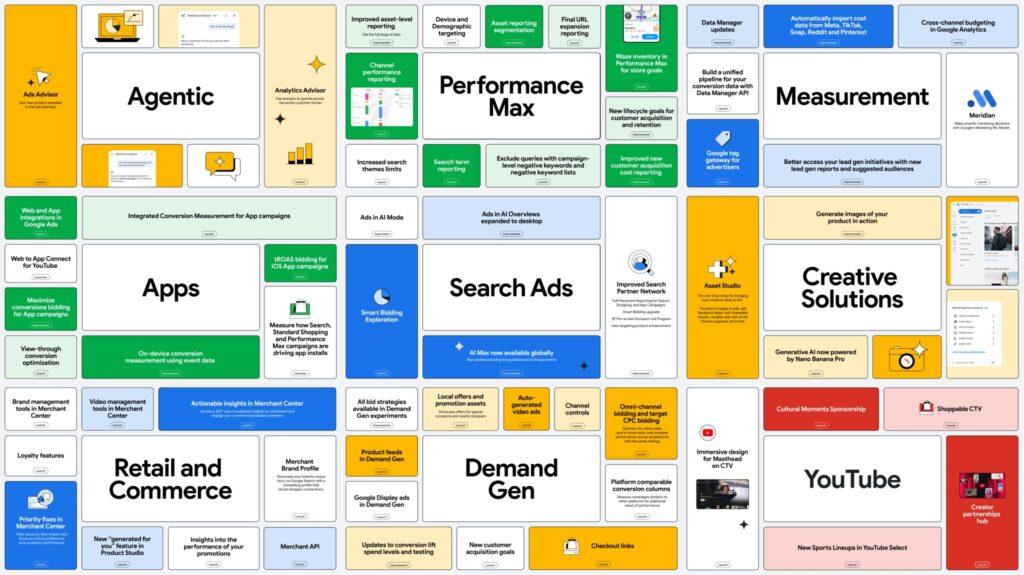
2025 has been the busiest year of Google Ads releases that I can remember. Luckily, Google released a great, if 11-page-long, summary of the biggest releases of 2025.
If that is too long for you, though, here are a few reflections on the year in Google Ads – and some of the biggest changes that have had the greatest impact so far.
Google Releases AI Max
Google announced that it would start showing ads in AI overviews in 2024, but never said how. In 2025, the “how” was revealed with the launch of AI Max, allowing advertisers to expand into AI searches based on the relevance of their ad and landing page to the user’s query and intent.
The important disclaimer is that Google has not yet released reporting showing how those placements are specifically performing. Still, results on a high level seem favorable – clients we’ve been testing for have seen a reduction in high cost per acquisition since the mode was enabled.
Google AI Overview Transparency
While Google has not yet provided transparency into how ads are performing in the AI overviews, it has finally released other reporting transparency that advertisers have been craving. In particular, the release of PMax Channel Reporting and Asset-level reporting for PMax were really critical and valuable developments.
Now advertisers are more easily able to see what assets are and aren’t performing, even in campaigns using AI-based bidding and AI-optimized ad assets. Hopefully, the next step in 2026 will be allowing advertisers to make adjustments to how their PMax campaigns are serving based on the Channel-Level reports and control which channels the campaigns serve on.
PMax Placements
Although Google has yet to allow users to control the placements of their PMax campaigns, Google significantly enhanced the controls on placements in Demand Gen campaigns. Advertisers can specifically decide if they want campaigns to show on Discover, Gmail, YouTube Shorts, and more.
Now they can even be designed and optimized specifically for YouTube Shorts, which is a really exciting development.
Google’s Take On Video
We continue to see strong performance from our Video Action campaigns, even though the Video Action campaign type was technically sunsetted in 2025 and is now instead running via Demand Gen campaigns. This has been a big relief. Video has been an incredible tool for driving efficient conversions, and Google’s new Nano Banana Pro resources, among others, open up many exciting new possibilities for creating more video content.
I’m glad Google took so many steps in the right direction in 2025 – with more control and transparency, as well as some promising new placements, there is a lot for performance marketers to be excited about. Looking forward to seeing if Google fills in some of the gaps in 2026 and beyond!
To read about Google’s “Year In Review,” click here.